Idea → UX Research → Wireframe →
UI Generator → Asset Generator → Dev Handoff.
This is the workflow most UX teams are describing in 2026 , an agent chain where human prompts go in and design-system-aware, production-ready output comes out. Below is the pipeline I run, the tools I pair at each stage, and the shift that makes this year different from every year before it.
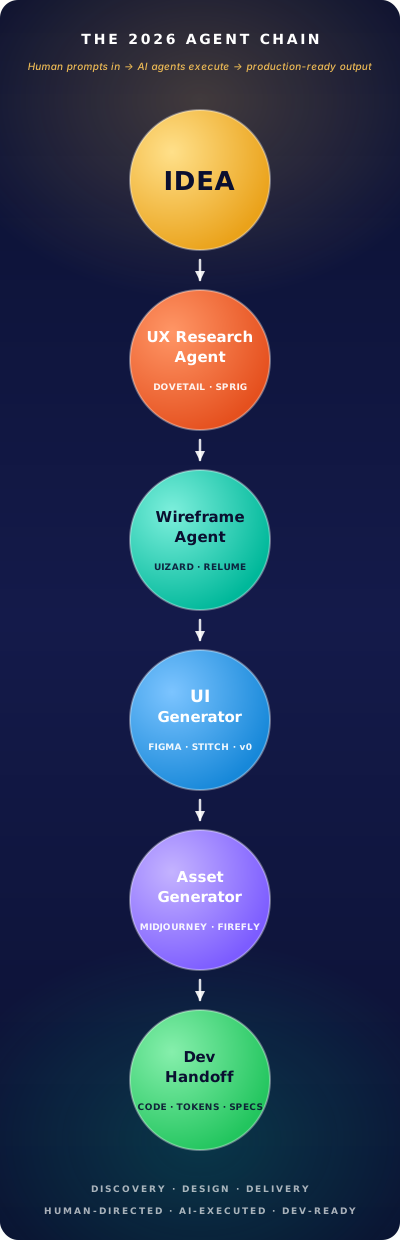
The 2026 workflow most teams are describing is an agent chain: Idea → UX Research Agent → Wireframe Agent → UI Generator → Asset Generator → Dev Handoff.
, UX and AI Resources, October 2026Human-directed intent
The chain starts with a prompt: a problem to solve, a user to serve, an opportunity to pressure-test. I own the brief.
Dovetail · Sprig · UX Pilot
Agentic synthesis of interviews, surveys, and behavior. Patterns surface in minutes; synthetic testers pressure-test before real users.
Uizard · Relume
Prompts and sketches become sitemaps and low-fi flows. Structure first, before pixels , I curate and redirect.
Figma Make · Stitch · v0
Hi-fi screens generated against the live design system , brand-consistent, not generic. The 2026 shift: tools understand your tokens.
Midjourney · Firefly
Illustration, imagery, icon systems, and marketing visuals produced on-spec and on-brand. No more stock-photo compromises.
Claude Code · Copilot · v0
Figma to production HTML/CSS/React. Handoff stops being a wall; the design that ships is the design that was approved.
The notable shift this year
Tools now understand design systems and brand consistency rather than producing generic templates , and “synthetic user” testing (Uxia, Sprig) pressure-tests designs before real user studies. That is why the chain works end-to-end in 2026, where in 2024 it broke at every seam.
AI agents I run inside the chain
Mapped to the six stages above , the exact tools UX professionals are deploying in 2026, sourced from the UX & AI Resources index.
UX Research & Synthesis
- Dovetail , agentic synthesis; auto-themes across interviews & surveys
- Sprig AI , Design, Field, & Synthesize agents for open-ended data
- Maze , AI-first usability + prototype validation
- UX Pilot , interview-question generation
- Uxia , synthetic AI testers for early rounds
- Claude / ChatGPT , affinity mapping, persona drafts
Wireframes & Sitemaps
- Uizard , rapid wireframes from prompts & sketches
- Relume , AI sitemaps & wireframes for web / marketing
- Google Stitch , prompts → multi-screen flows
- Claude Design , low-fi exploration + system reasoning
UI Generation
- Figma AI / Figma Make , hi-fi UI aware of your design system
- Google Stitch , exports to Figma or code
- v0 (Vercel) , production-ready web UI from language
- Framer AI , prototype & site generation
Asset Generation
- Midjourney , brand imagery, illustration, hero visuals
- Adobe Firefly , vector, icon systems, brand-safe assets
- Figma Make , in-context component variants & states
Accessibility & Validation
- Stark , AI-powered contrast & WCAG auditing
- Attention Insight , predictive heatmaps pre-launch
- Miro AI , clustering, summarization on shared boards
- Jotform AI Agents , research-pipeline automation
Dev Handoff
- Claude Code , Figma → production React / HTML / CSS
- GitHub Copilot , in-IDE pair for test & refactor
- v0 (Vercel) , UI → deployable Next.js
- DeepSeek , reasoning for component architecture
Speed without sacrifice
What used to take weeks of prototyping now takes hours. AI handles the repetitive 70%, the boilerplate, the variants, the documentation, so I spend my time on the 30% only a human can do: judgment, taste, and empathy.
Insight you cannot fake
Claude can ingest 800 pages of research, 10,000 customer reviews, and a year of analytics, then surface the three patterns that actually matter. No more design decisions based on the loudest stakeholder in the room.
Design that survives prod
AI pairs with me on the prototype code itself, accessibility checks, edge cases, responsive states, performance budgets. The design that ships looks like the design that was approved, because the gap closed.